
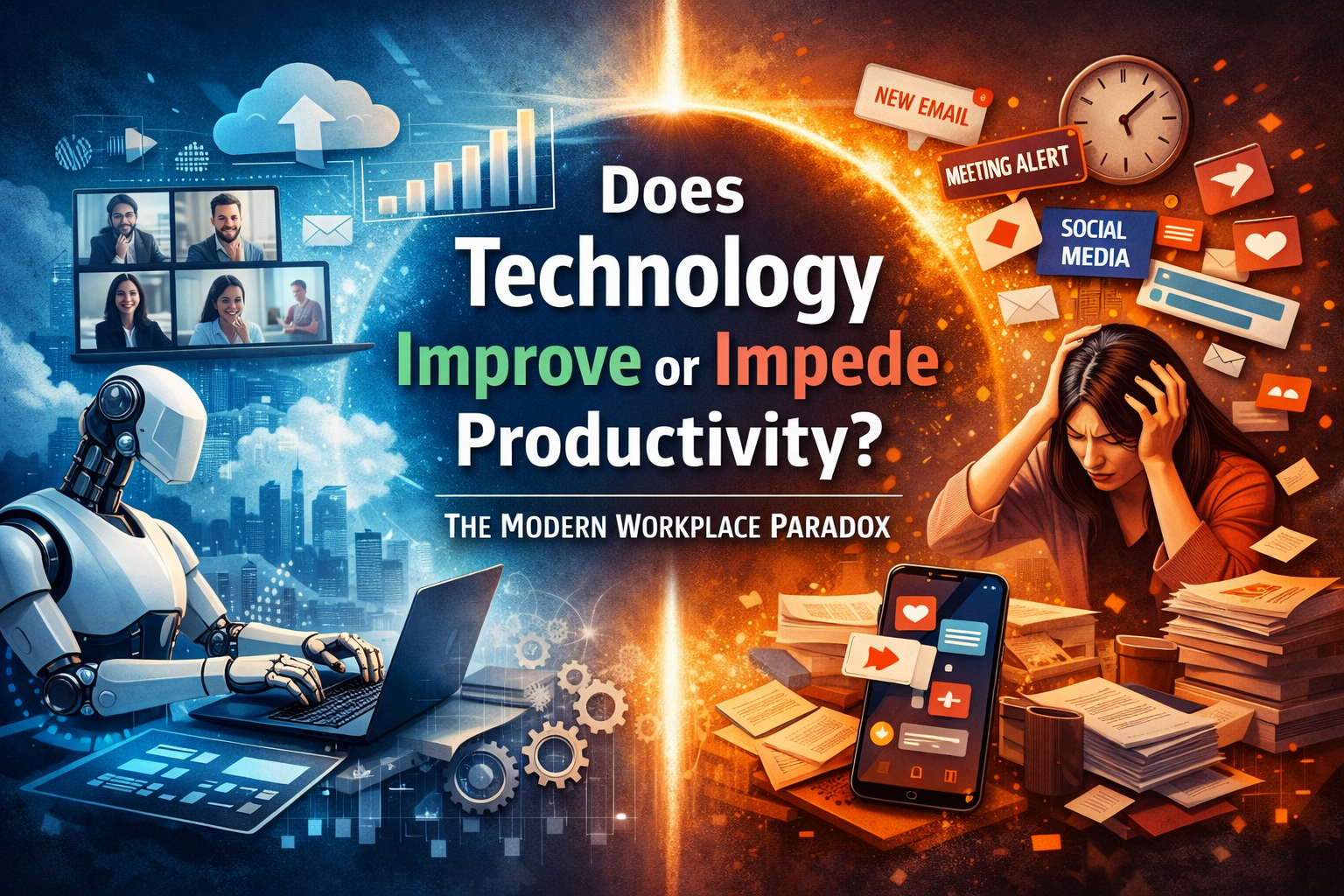
The Productivity Question of Our Time
Technology was designed to make work easier, faster, and more efficient. From email and cloud computing to artificial intelligence and automation, digital tools promise unprecedented productivity gains. Yet paradoxically, many organizations and individuals feel busier than ever, overloaded with notifications, endless meetings, and digital fatigue.
This contradiction poses a significant question for contemporary workplaces: does technology truly enhance productivity, or has it become one of its foremost impediments?
The answer is not a simple yes or no. Technology can both enhance and undermine productivity, depending on how it is designed, adopted, and managed.
How Technology Improves Productivity
1. Automation of Routine Tasks
Technology excels at handling repetitive and time-consuming work. Automated systems reduce human effort in tasks such as data entry, invoicing, scheduling, and reporting. This frees employees to focus on higher-value activities like problem-solving, creativity, and strategy.
In sectors such as finance, manufacturing, and logistics, automation has significantly reduced processing time and operational errors, directly improving output quality and speed.

2. Faster Communication and Collaboration
Digital communication tools have transformed how teams work. Email, instant messaging, video conferencing, and shared workspaces allow real-time collaboration across cities, countries, and time zones.
Remote and hybrid work models powered by technology have expanded access to talent, reduced commuting time, and enabled flexible work arrangements, all of which can boost individual and organizational productivity.
3. Access to Information and Knowledge
Cloud platforms, digital libraries, and search engines place vast amounts of information at employees’ fingertips. Knowledge that once took days or weeks to access is now available in seconds, accelerating decision-making and reducing dependency on hierarchical information flows.
4. Performance Tracking and Optimization
Modern productivity tools offer details about workflows, timelines, and resource utilization. Organizations can now identify bottlenecks, optimize processes, and measure performance more accurately, leading to continuous improvement.

How Technology Impedes Productivity
1. Digital Distractions and Interruptions
The same tools designed to improve efficiency often fragment attention. Constant notifications, emails, and instant messages disrupt deep work and reduce cognitive focus.
Research shows that frequent task-switching increases mental fatigue and lowers the quality of output, even if people feel “busy” throughout the day.
2. Information Overload
Technology has made it easy to generate and share information, but not necessarily to manage it well. Employees often spend excessive time sorting through emails, dashboards, documents, and updates, leaving less time for meaningful work.
When everything appears urgent, true priorities often suffer.
3. Tool Proliferation and Complexity
Many organizations adopt multiple platforms for similar functions, such as project management, communication, and reporting, without clear integration or guidance. Instead of simplifying work, technology becomes an added layer of complexity that employees must constantly navigate.

4. Burnout and Always-On Culture
Technology blurs the boundaries between work and personal life. The expectation to be constantly reachable can extend working hours, increase stress, and ultimately reduce long-term productivity through burnout, disengagement, and turnover.
The Real Issue: Technology Is a Multiplier, Not a Solution
Technology does not automatically create productivity; it amplifies existing systems and behaviors.
-
In well-structured organizations, technology accelerates efficiency and innovation.
-
In poorly managed environments, it magnifies confusion, overload, and inefficiency.
Productivity outcomes depend less on the tools themselves and more on how people use them.

Making Technology Work for Productivity
To ensure technology improves rather than impedes productivity, organizations should:
-
Adopt tools with a clear purpose, not trends.
-
Limit unnecessary notifications and meetings to protect focus time.
-
Invest in digital skills and change management, not just software.
-
Align technology with human workflows, not force humans to adapt to tools.
-
Encourage boundaries and healthy work habits to prevent burnout.
Conclusion: A Balanced Perspective
Technology is neither the hero nor the villain of productivity; it is a powerful enabler. When aligned with thoughtful leadership, clear processes, and human-centered design, it can unlock extraordinary efficiency and creativity. When misused or unmanaged, it becomes a source of distraction, stress, and diminishing returns.
The real productivity challenge, therefore, is not about choosing more technology but about choosing better ways to work with it.

Loved reading this